This guide explains everything step-by-step in a clear and practical way.

Buying a condominium in Thailand as a foreigner is one of the easiest ways to own property legally in the country. However, there are specific legal requirements, documents, and costs you must understand before making a purchase.
This guide explains everything step-by-step in a clear and practical way.
🧾 1. Can Foreigners Buy Property in Thailand?
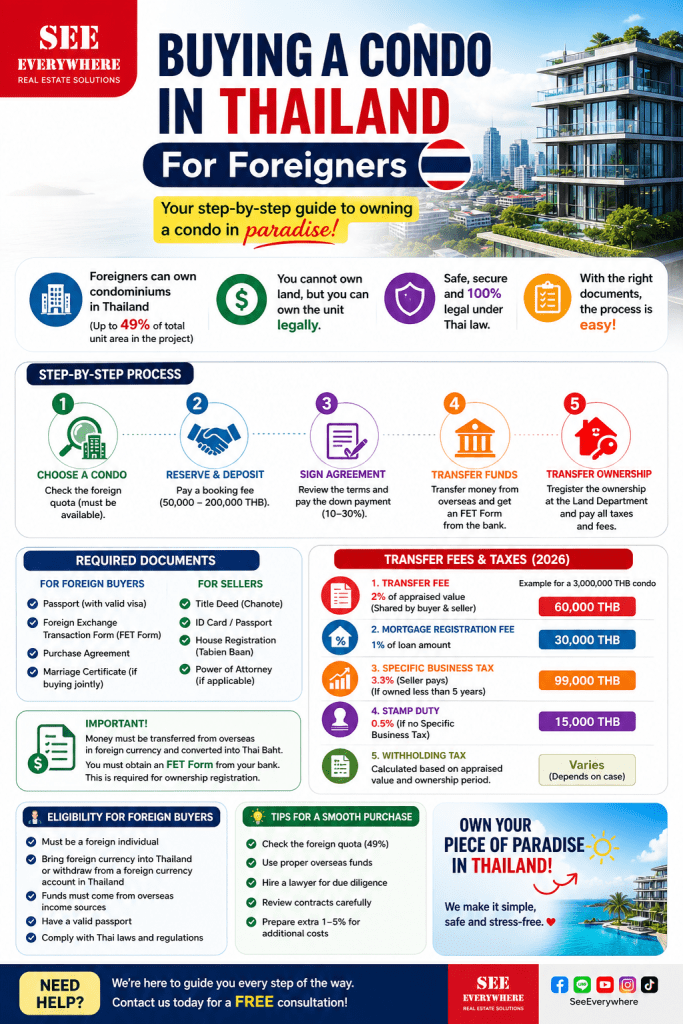
Foreigners cannot own land in Thailand, but they are allowed to own condominium units under the Condominium Act B.E. 2522.
✅ Key Rule:
- Foreign ownership in a condominium project must not exceed 49% of total unit area
👤 2. Eligibility Requirements for Foreign Buyers
To legally purchase a condo in Thailand, a foreigner must:
✔ Meet ONE of the following conditions:
- Bring foreign currency into Thailand
- Withdraw funds from a foreign currency account in Thailand
- Use funds from overseas income sources
✔ Additional requirements:
- Must have a valid passport
- Must comply with Thai laws and regulations
- Funds must be properly documented
💰 3. Proof of Funds (Very Important)
The most critical document is the:
📄 Foreign Exchange Transaction Form (FET Form)
Issued by banks in Thailand to confirm that:
- Money was transferred from overseas
- Currency was converted into Thai Baht
👉 This is required by the Land Department for ownership registration
📑 4. Required Documents for Foreign Buyers
🧍 Buyer’s Documents
- Passport (with valid visa)
- FET Form (Foreign Exchange Transaction Form)
- Purchase agreement
- Marriage certificate (if buying jointly)
🏢 Seller’s Documents
- Title deed (Chanote)
- ID card / passport
- House registration (Tabien Baan)
- Power of attorney (if applicable)
🏦 Additional Documents (if using a lawyer or agent)
- Power of Attorney (PoA)
- Legal representation documents
🪜 5. Step-by-Step Buying Process
Step 1: Choose a Condominium
- Verify ownership quota (foreign quota must be available)
- Check developer credibility
Step 2: Reservation & Deposit
- Pay booking fee (usually 50,000 – 200,000 THB)
Step 3: Sign Sales & Purchase Agreement
- Review terms carefully
- Pay down payment (typically 10–30%)
Step 4: Transfer Funds from Overseas
- Transfer money in foreign currency
- Obtain FET Form from your bank
Step 5: Ownership Transfer at Land Office
- Register ownership at the Land Department
- Pay all taxes and fees
💸 6. Transfer Fees & Taxes (2026)
Here are the main costs involved:
🧾 1) Transfer Fee
- Standard: 2% of appraised value
- Usually shared between buyer and seller
🏦 2) Mortgage Registration Fee (if applicable)
- 1% of loan amount
📊 3) Specific Business Tax
- 3.3% (paid by seller if owned < 5 years)
🧾 4) Stamp Duty
- 0.5% (if no Specific Business Tax)
💰 5) Withholding Tax
- Calculated based on appraised value and ownership period
👉 Based on regulations from the Revenue Department
📊 7. Example of Total Costs
For a 3,000,000 THB condo:
- Transfer Fee: 60,000 THB
- Mortgage Fee: 30,000 THB
👉 Estimated total: 90,000 THB
⚠️ 8. Important Tips for Foreign Buyers
✔ Always check the foreign ownership quota (49%)
✔ Ensure funds come from overseas (for FET Form)
✔ Hire a lawyer for due diligence
✔ Review contracts carefully
✔ Prepare extra 1–5% for additional costs
🚫 9. Common Mistakes to Avoid
❌ Transferring money without proper documentation
❌ Buying in a project with no foreign quota left
❌ Not checking title deed authenticity
❌ Ignoring hidden costs
🎯 Conclusion
Buying a condominium in Thailand as a foreigner is straightforward and secure if you:
- Follow legal requirements
- Prepare correct documents
- Understand all transfer costs
👉 With proper planning, you can avoid unnecessary expenses and ensure a smooth ownership transfer.
📣 Need Help?
If you are looking to buy a condo in Thailand or need help calculating total costs:
👉 Visit: https://propertygrow.co/
👉 Or contact us for a free consultation
📚 References
- Land Department
- Revenue Department
- Condominium Act B.E. 2522